+44 1545 900065
.png)


.png)
 15-30 day return policy
 Rated excellent
 Fast delivery 3-6 days
 Pay later with invoice, 15-30 day credit, Always interest-free
The Architectural Imperative for WAN Modernization
For decades, enterprise wide-area networking relied completely on Multiprotocol Label Switching (MPLS) to connect remote locations stably. Private label-switched tunnels provided strict delivery guarantees, predictable frame latency, and reliable uptimes. This setup fit perfectly when corporate data centers hosted all database assets and applications locally.
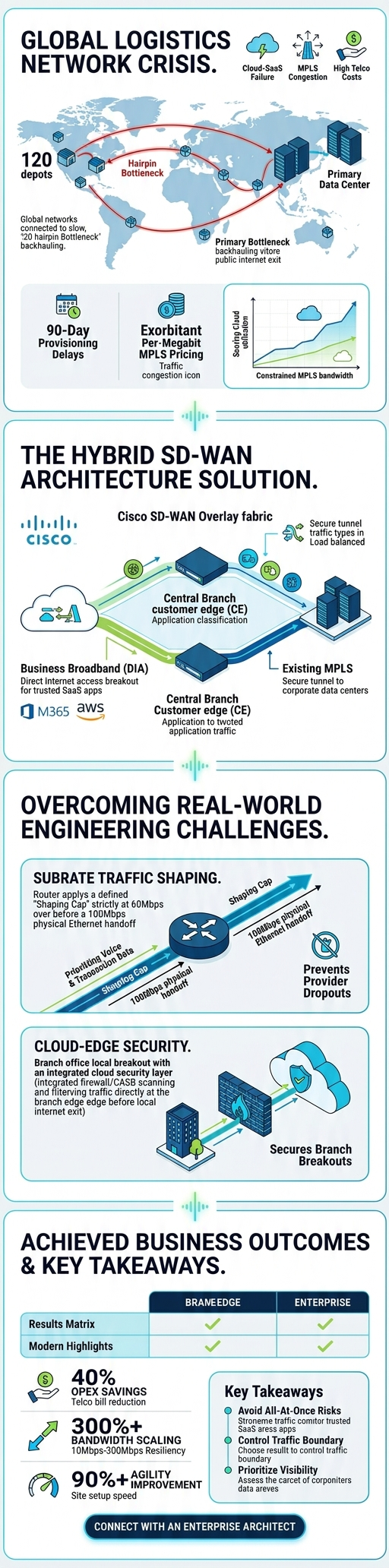
However, the rapid relocation of business software to multi-cloud ecosystems exposes structural flaws in static hub-and-spoke setups. Routing internet-bound cloud application traffic over long private backhaul lines to a corporate hub before letting it out through a centralized firewall degrades performance. This roundabout path, often called the "hairpin effect," adds noticeable delay to web services, raises cloud storage overhead, and strains expensive corporate infrastructure links.
To fix these efficiency bottlenecks, modern enterprises are adopting Software-Defined Wide Area Networking (SD-WAN). This approach moves control-plane management from manual on-box setups to unified central controllers, abstracting physical connections into a flexible virtual network mesh. This transformation allows companies to combine low-cost business broadband, cellular networks, and remaining legacy links into an automated, highly visible transport network.
An Inside Look: Global Logistics Corporation Case Study
To see how this transformation functions in production, let us analyze the network overhaul at Global Logistics Corp (GLC). GLC manages 120 supply depots, shipping terminals, and fulfillment hubs alongside two primary data center environments. Their legacy setup depended entirely on managed provider lines, leading to critical operational challenges:
- Cloud Delivery Failure: High-bandwidth video applications, tracking databases, and production software faced constant dropped frames because of backhaul bottlenecks.
- Prohibitive Scale Costs: Adding private circuit bandwidth to support growing web logging and tracking data was too expensive to sustain.
- Agility Constraints: Launching new sorting facilities often took two to three months due to long telco provisioning timelines.
- Siloed Monitoring: Network teams could not see exactly what applications were flooding lines at individual locations until packet drops caused site slowdowns.
Rather than implementing an all-at-once replacement, GLC engineers planned a safer, phased hybrid migration strategy. This method kept existing lines running for critical back-end databases while rolling out direct internet access connections across their entire footprint.
GLC's phased hybrid migration successfully minimized risk by deploying software-defined gateway appliances alongside active legacy customer-edge setups. This preserved core database access while allowing low-risk traffic classes to shift to public broadband links over a nine-month transition window.
Overcoming Technical Implementation Challenges
Replacing core enterprise networking architecture introduces real-world configuration challenges. Moving beyond simple marketing claims reveals complex engineering problems that occur during real-world deployments.
1. Managing Provider Line Dropouts via Egress Traffic Shaping
During deployment, GLC added high-speed business broadband connections capped below wire speed—specifically 60 Mbps profiles over 100 Mbps physical Ethernet handoffs. Initial testing showed severe packet drops during peak hours because the service provider dropped any traffic exceeding the contracted limit.
Because the service provider instantly discarded bursts over 60 Mbps, standard customer-edge queuing policies could not manage priorities effectively. To solve this, GLC engineers configured strict outbound traffic shaping on their branch edge appliances to match the 60 Mbps cap. By moving the intentional bottleneck to the local device, the internal scheduling system successfully prioritized business data and communication streams over general web traffic during busy periods.
2. Dynamic Path Correction and Failover Tuning
A major design goal was enabling active-active multi-path routing across both broadband lines and remaining private lines. The network needed to move traffic away from lines experiencing sudden performance drops without dropping active application connections.
Engineers set up software controllers to run continuous loop validation checks across all active virtual tunnels. By monitoring jitter, packet loss, and latency, the system adapted dynamically. If a broadband provider experienced a sudden performance drop, the edge appliance shifted high-priority application flows to a stable line within milliseconds, keeping users connected seamlessly.
3. Securing Local Internet Breakouts
Allowing branch locations to access the internet directly improved performance but bypassed the security of the central data center firewall. This shift created major security risks at every remote site.
GLC handled this by embedding advanced local cloud security controls and zone-based firewall rule sets directly onto the branch edge devices. This approach ensured that local internet traffic received complete threat prevention and web filtering directly at the branch edge, keeping the network secure without adding latency.
Comparing Performance and Strategic Outcomes
The operational and financial results achieved over the multi-month transition highlight the efficiency gains of moving from hardware-centric lines to a software-defined hybrid model:
| Performance Dimension | Legacy Core Architecture | Software-Defined Hybrid Model | Measured Impact |
|---|---|---|---|
| Monthly Network Operating Expenses | $145,000 / month | $87,000 / month | 40% Cost Reduction |
| Available Branch Bandwidth | 10 Mbps – 20 Mbps limit | 100 Mbps – 300 Mbps pool | 300%+ Scale Increase |
| Site Setup Provisioning Time | 60 to 90 Days telco wait | Under 5 Days deployment | 90%+ Speed Improvement |
| Cloud Application Path Routing | Centralized core backhaul | Direct, local optimization | Latency dropped by 15ms |
| Line Redundancy Design | Passive backup line standby | Active-active path routing | Zero app interruptions |
Phased Migration Blueprint
GLC avoided widespread outages by following a carefully structured implementation timeline:
- Phase 1: Overlay Evaluation (Months 1-2): Virtual network nodes were deployed at major hubs alongside legacy setups. Dynamic routing protocols used custom multi-exit discriminators to route data safely between old and new systems.
- Phase 2: Local Breakout Integration (Months 3-6): Business broadband lines were added at all branch locations. Direct access rules moved trusted cloud traffic to the new lines, removing half the load from the old data center core.
- Phase 3: Final Optimization (Months 7-9): Once the new system was stable, expensive legacy lines at small remote offices were scaled down or replaced entirely with dual-broadband connections to lock in operational savings.
Our Network Migration Offerings
Custom enterprise transition services designed to modernize infrastructure without interrupting live operations.
WAN Readiness Assessment
We analyze application flows, line utilization, and cloud dependency paths to design a custom, low-risk transition blueprint for your network.
Edge Control Architecture
Our engineers set up precision traffic shaping, subrate bandwidth profiling, and smart path management to prevent data drops on provider lines.
Cloud Edge Security
We build secure local internet breakouts with embedded zone firewalls and cloud access security tools to protect data directly at the branch edge.
Core Lessons for Infrastructure Leaders
- Avoid All-At-Once Risks: Using a hybrid setup allows you to test new paths while keeping critical legacy systems running safely in the background.
- Control the Traffic Boundary: Setting up traffic shaping on your edge devices protects you from service provider drops when using subrate internet profiles.
- Prioritize Application Visibility: Centralizing network management transforms your visibility, letting teams fix bottlenecks before they cause downtime.